

Key takeaways
- 1. Simultaneous submissions to literary agents are the default; exclusivity is the exception and only applies for a stated window.
- 2. Disclose simultaneous status in one sentence near the end of your query letter unless the agent's guidelines say notice is unnecessary.
- 3. Query in waves of 8-12 agents so response data can shape your list (and you can shape your query as well) before you exhaust it.
- 4. When an offer arrives, notify every agent still holding your manuscript the same day and set a one-to-two-week decision deadline.
- 5. Track agent name, dates sent, exclusivity flags, response windows, and an offer-in-hand status to avoid the three common etiquette mistakes.
The etiquette lives in four places: disclosing that you're querying widely, respecting stated response windows, handling the offer call, and withdrawing cleanly. Each rule maps to a field in your query log, and this piece gives you the exact fields, the window math, and the scripts.
What does simultaneous submissions to literary agents mean?
Simultaneous submissions to literary agents mean querying the same manuscript to several agents at once, rather than waiting for each one to reply before sending the next. You disclose in the query that agents at other agencies also have it.Simultaneous vs. Exclusive: the two submission modes
Exclusive submission is the opposite arrangement: one agent reads the manuscript alone for an agreed window, and you send nothing elsewhere until that window closes. Exclusives are rarer for initial queries and more common when an agent requests a revise-and-resubmit. The Association of American Literary Agents treats disclosure of simultaneous status as standard query etiquette.Why agents would expect multiple submissions
Rarely, an agent might ask if you have other writing ready, or if a series, other parts written, and will ask for those as well.Are simultaneous submissions to literary agents allowed?
Yes, and as the norm. Most agents expect that you will query multiple agents at once, because response times often run months and waiting on one agent at a time could stretch a full manuscript query into years. Exclusivity is the exception, never the default.Where agents state their policy
Check each agent's own page or blogs or social media pages first. Most list their policy under submission guidelines. Or got to the agency's submission guidelines page. They often phrase as "we accept simultaneous submissions" or "we request a two-week exclusive." QueryTracker lets you filter agents by that policy before you add anyone to your query log. If an agent's page is silent, treat it as open unless they tell you otherwise.When an agent asks for an exclusive
An exclusive request means no other agent may read the manuscript during the stated window, typically two to four weeks. You can decline, negotiate a shorter window, or accept, but you must tell any agent who already has it. Accepting and staying silent is the etiquette mistake that burns relationships. Log the exclusivity start date, the end date, and who you notified, and set a reminder to nudge the agent the day it expires.How do you tell an agent you are submitting simultaneously?
You mention it in the query letter, in one sentence, near the end. Agents expect simultaneous submissions and most don't require disclosure, but stating it signals you know the etiquette. Many agents list their query policies, including whether they accept simultaneous submissions, on their pages at QueryTracker, so check before you send.Query letter phrasing that works
One line does the job: "This is a simultaneous submission, and I will withdraw promptly if another agent offers representation." Or, for exclusive-reading agents, "This is an exclusive submission to you for 60 days." Keep it to a single sentence after your pitch or before your closing.When not to mention other submissions
Leave the line out when the agent's guidelines state they accept simultaneous submissions without notice, or when you're querying exclusively. If you log each query's disclosure status in your tracker, you'll never contradict yourself across 30 agents. Submarine's query log stores those notes and emails per agent and submission, and its privacy policy covers how your manuscript data is handled.How many agents can you query at once?
There is no cap. Most agents and agencies that accept simultaneous submissions expect you to query widely, and etiquette rules only require that you disclose. The practical question is batch size, and the answer most experienced queriers land on is 8-12 per wave. A wave gives you statistically meaningful response data before you commit the rest of your agent list, and it protects you from burning 40 queries on an opening chapter that gets form rejections across the board.Batching in waves: a worked example
Say you have 36 agents on your list. Send 12 in week one, all marked as simultaneous submissions. If 10 come back as form rejections within a month, you revise the opening before sending wave two. If half request fulls, you send the next 12 with confidence. One writer running this math on a 36-agent list spends at most two rounds instead of discovering a chapter problem after all 36 are gone.Reading your own response-time data
Your query log should record sent date, response date, and response type per agent. After one wave you can compute your median response time and spot the agents whose silence has run past their stated reading window. Log each wave's outcome and the pattern tells you whether the pages, the comp titles, or the query itself needs work.What do you do when an agent offers while others still have your manuscript?
Reply to the offering agent first to accept the offer, then notify every agent still holding your pages the same day. Agencies state their own offer policies in their guidelines, so check each one before you query; some ask for a nudge email, others ask you not to notify until you have accepted.The notification email, word for word
Or close to it. Use your voice, of course. Keep it to three sentences: "I wanted to let you know that I've received an offer of representation for [TITLE]. I'm setting a decision deadline of [date]. If you'd like to consider the manuscript, I'm happy to send anything you need."Setting and enforcing your decision deadline
One to two weeks is the customary window. Agents who want the manuscript will read fast; silence past your deadline is an answer. When the deadline arrives, email the offering agent to accept, then send a short withdrawal note to everyone else. Log the deadline date in your tracker the moment you send the notification, not later.Handling a second offer
First off: look at you! Second: if a second offer lands before you decide, tell both agents immediately and let them know you're weighing two offers. Never let one agent believe they are your only option.How do you withdraw a simultaneous submission?
Full vs. partial withdrawal
Withdrawal email template
Keep it short and factual. For a full withdrawal: "Dear [Agent], I'm writing to withdraw [Title] from consideration, as I've accepted an offer of representation. Thank you for your time." For a partial withdrawal: "Dear [Agent], I wanted to let you know that [Title] has received a full manuscript request from another agent. I'm happy to keep the query active, but wanted to disclose it per your guidelines." Send it as a reply to your original query thread so the agent has context without searching.What withdrawal does to your tracker record
Log the withdrawal date, the type (full or partial), and the reason. A full withdrawal closes the record; a partial one stays open until the agent responds. Keep the record even after closing, since response-time history tells you which agents are worth nudging and which are not.How do you track simultaneous submissions without making mistakes?
The query log fields that matter
Track these per query: agent name, agency, date sent, materials sent (full, partial, pages), exclusivity flag and its end date, response window in days, nudge date, status (waiting / pass / offer / withdrawn), and notes. The status column needs an "offer in hand" state, not just open and closed, because that state drives your deadline math. If an agent's page says, "If you haven't heard back from them in six weeks, it's a pass," use the 'No Response By (auto no-answer date)' field in the submission entry form in Submarine, and it will notify you when that time is up so you can resubmit to other agents at the same agency.Three spreadsheet mistakes that cause etiquette errors
First, forgotten exclusivity flags: an agent asks for two weeks exclusive, you agree, then query four more people on day nine. Second, stale response windows: agency guidelines change, your formula still says 60 days, and you nudge early. Third, no offer-readiness state: when the call comes, agents expect decisions fast; trade coverage of offer calls stresses that writers juggling multiple offers need to know within days who else has the full (Publisher's Weekly).
Running the same workflow in a dedicated tracker
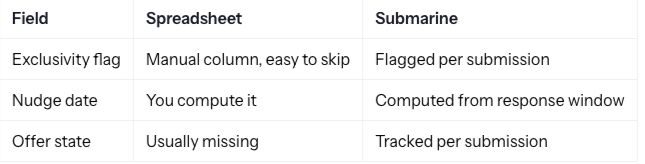
(https://submarinetracker.app/) runs the same fields without formula maintenance, on web and iOS, so your litmag reading periods and agent queries live in one log. The honest caveat: any tracker only works if you log the date correctly of when you sent it. You don't have to always log it the same day. Submarine knows how writers are. Sometimes you get to it the next day. Click yesterday's date and Submarine will start the clock from then.
Which submission tracker fits a writer querying agents and litmags at once
Comparison criteria
Judge any tracker on four things: market data (does it cover both litmags and agents?), tracking (can it log 20+ active submissions with dates and response windows?), simultaneous-submission flags (does it show which markets allow them?), and cost transparency (is the price visible before you commit?).How the tools compare
Duotrope covers litmags and agents but sits behind a subscription. The Submission Grinder is free with response-time data, though readers describe the interface as dated. Chill Subs has a large market database, with paid tiers some find pricey. QueryTracker focuses on agents. Ledgeromatic is adjacent, aimed at poetry submissions. Submittable handles a good number of journals, some publishers, and a minimal number of agents but does little for the submitter.
Where Submarine fits, honestly
Submarine is built for tracking: one command deck for every query, story, poem, screenplay, and song, on web and iOS. Run against the same criteria: its strength is the query log itself, with reading windows and withdrawal status per piece. Its market database is thinner than Duotrope's or Chill Subs', so pair it with a market list rather than expecting one tool to do both jobs.Submarine won't submit for you (at least not yet)
...and although I would love to automatically update your Submittable, Duosoma, and email inbox returns, that becomes another level of trusting me with your information that I haven't earned yet. I know I wouldn't give that info up to a start-up software company that hasn't earned my trust yet. But I've tried to make it so easy to add a submission and to update them that it almost feels automatic. And it syncs with the iOS app, so you can do it on the go.
Now back to submitting to agents and some...
FAQs
Do you have to say your submission is simultaneous in a query letter?
Most agents don't require it, but one sentence near the end of your letter signals you know the etiquette: "This is a simultaneous submission, and I will withdraw promptly if another agent offers representation." Skip the line when the agent's guidelines accept simultaneous submissions without notice, or when you're querying exclusively. Log your disclosure choice per agent so you never contradict yourself.How long should you wait before nudging an agent who hasn't responded?
Wait until the agent's stated response window has passed, then send a short nudge. Record the window in days per query and compute a nudge date the moment you send, because agency guidelines change and a stale formula leads to nudging early. If the guidelines list no window, waiting eight or more weeks before a polite check-in is a reasonable default.Can you query the same agent at two different agencies at the same time?
No. One agent, one agency: querying the same person at a new agency reads as an error and wastes goodwill. What you can do is query different agents at different agencies, and even multiple agents within one agency if its guidelines permit it, though many agencies ask you to query only one of their agents at a time. Check each agency's submission page first.What happens if two agents offer representation on the same day?
Tell both agents immediately that you're weighing two offers, then set a decision deadline of one to two weeks and notify every other agent still holding your manuscript the same day. Never let either offering agent believe they are your only option. When the deadline arrives, accept one and send short withdrawal notes to everyone else, logging each date as you go.Is a simultaneous submission to an agent different from one to a literary magazine?
The mechanics are the same: multiple markets hold your piece at once, and you disclose it. The differences are in scale and stakes. Agent response windows run months rather than weeks, an offer triggers deadline math that litmag acceptances never require, and exclusives are far more common in agenting, especially after a revise-and-resubmit request. One log handles both.